The Algorithmic Rot, the Open Road, and the Undying Word
I have always believed that books displace us.
They tear us away from our familiar shores and drop us into worlds we did not ask to see, leaving us slightly altered by the time we close the cover.
But what happens when the world outside the book is designed to ensure we never sit still long enough to be altered?
What happens when our attention is no longer our own?
Today, that question ceased to be an abstract thought. It became a living conversation.
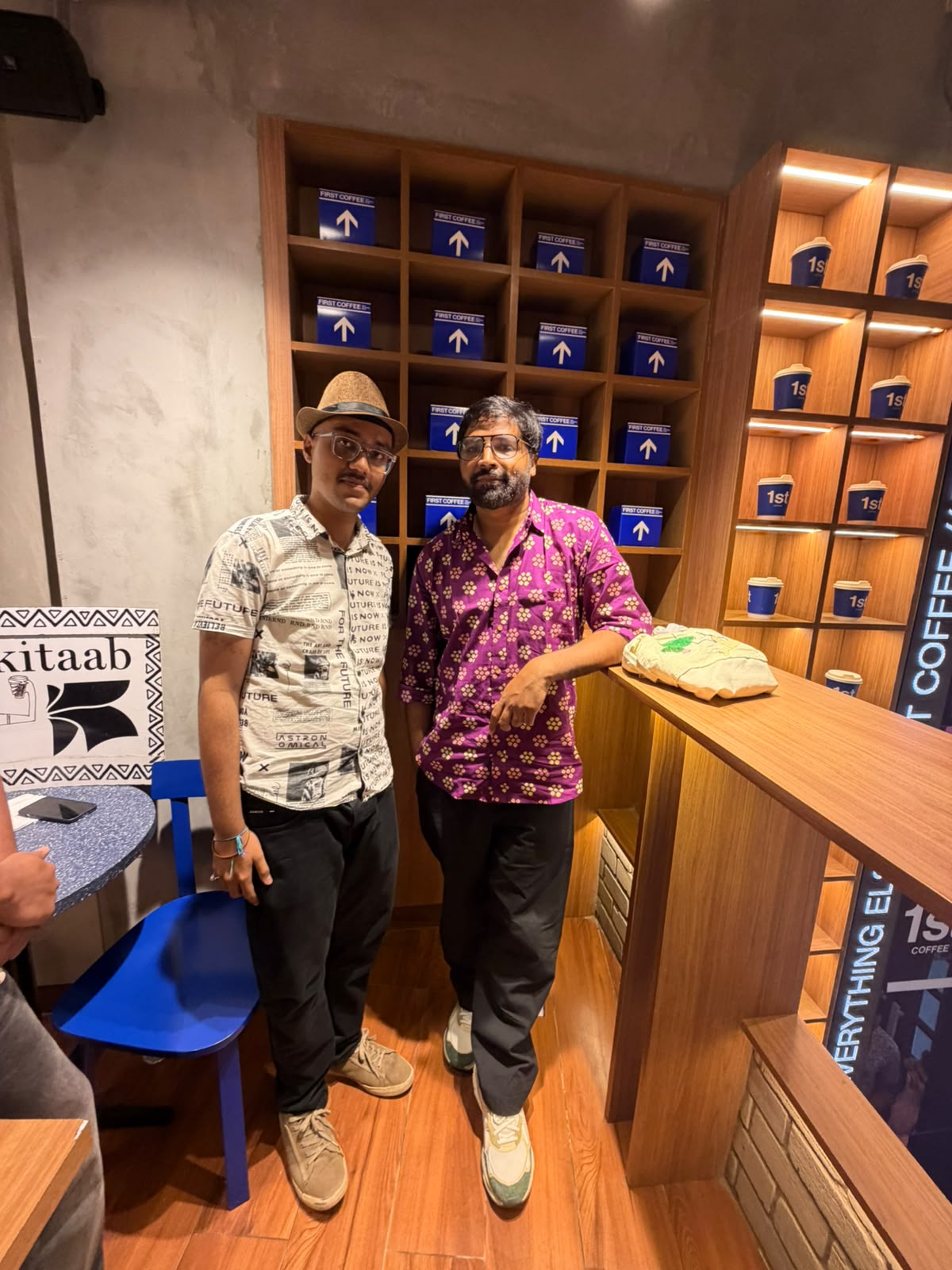
And for me, it marked a remarkable personal milestone—my very first meeting with Kitaab.
To dive straight into the deep end, I wasn’t just sitting in the audience; I was part of the core organizing team and stepped up as one of the main discussants for the session.
Sitting on that stage, looking across at multidisciplinary artist, filmmaker, and podcaster Anurag Minus Verma to unpack his debut full-length non-fiction book, The Great Indian Brain Rot: Love, Lies and Algorithms in Digital India, felt like pulling back the curtain on a mirror.
The Architecture of the Rot and Baudrillard’s Shadow
As an engineer, I am trained to understand structures.
I look at systems, logic, and the clean predictability of code.
But Anurag’s book maps a very different kind of infrastructure.
He charts the post-Jio digital deluge—the silent, unseen architecture of algorithms that trade on our loneliness, manufacture our desires, and turn human grief into content.
During our discussion, we dove deep into Jean Baudrillard’s philosophy of hyperreality—the unsettling idea that our media and digital screens no longer merely reflect reality; they replace it.
We live in a world where the copy has become more real than the original.
Anurag elegantly tied this to the modern socio-political landscape, where tough, urgent realities are routinely buried under an avalanche of media “word salad.”
It is a masterful tactic of distraction.
When asked about crisis, systemic issues, or deep social shifts, those in power construct a linguistic maze of empty jargon and deflection—a literal word salad designed to say absolutely nothing while sounding like everything.
The Illusion of Freedom
This brought us to the great paradox of our generation:
the illusion of digital liberty.
We often celebrate the internet and social media as democratic bastions of ultimate freedom.
On paper, it provides us unparalleled freedom—the power to publish, to voice, to create, and to reach millions without a traditional gatekeeper.
We are given the keys to an open kingdom.
But as our discussion unfolded, we peeled back the layers of this supposed liberation.
Is it true freedom, or is it just a highly manicured cage?
Social media gives us the freedom to speak, but the algorithm decides who gets to hear.
It traps us in echo chambers, feeds on our outrage, and conditions us to think in hashtags.
We are free to scroll infinitely, yet we find ourselves more trapped by online loneliness than ever before.
True freedom, we realized, isn’t just about having a megaphone on a platform; it is about having the autonomy to step away from the machine entirely.
The Map vs. The Route
Because I walk the line between the analytical world of engineering and the fluid landscapes of literature, I wanted to anchor this heavy critique into something actionable.
I asked him a question that sits heavily on the chests of so many STEM students:
How do you transition? What is the roadmap for a tech student who wants to be an artist, a creator, a writer?
In the tech world, we are obsessed with roadmaps.
We want blueprints, structured pathways, and predictable formulas for success.
We want a checklist that guarantees an arrival.
But Anurag’s response shattered the very idea of the map.
He reminded us that in creative expression, there are no standardized tracks.
“There is no one path you can follow to succeed in any field. Everyone has his own routes to their destinations.”
To search for a fixed formula to become an artist is to misunderstand art entirely.
Your route will not look like mine. It cannot.
And then, he left us with a truth that was as simple as it was heavy—a baseline requirement for anyone trying to survive the rigid boxes society builds for us:
“To become a writer, what you need is to never let your love for writing die.”
Page Two
This was my first meeting with Kitaab, running behind the scenes and steering the mic, and it serves as my second page here at TheWittySwan.
If my first piece was about how we borrow lives from the dead writers who came before us, this one is a reflection on how we protect our own lives from the digital hyperreality we build today.
Engineering can build the digital highways we traverse every hour.
But it is the undying love for a sentence, a story, or a canvas that ensures we don’t lose our minds to the word salad of the algorithmic age.
The digital world keeps scrolling.
The algorithm keeps optimizing.
But the Swan keeps flying, charting its own unmapped routes, one page at a time.
— TheWittySwan 🦢📚